African Grey Parrots: UK Facts, Price & Care Guide
African Grey Parrots: The Complete UK Guide to Facts, Price and Care
If you have ever watched a video of a parrot holding a full conversation, chances are it was an African Grey. These birds are famous for their vocabulary, their sharp minds, and their long lives. But before you search “African Grey parrot for sale UK” or “African Grey parrots near me” and get carried away, it helps to know exactly what you would be taking on.
This guide covers the real facts about African Grey Parrots: their size, habitat, lifespan, intelligence, price in the UK, and what daily care actually involves, including the health issues and behavioural quirks most sales pages leave out. If you are also looking at other large parrot species, our Macaw Parrot Guide covers a similarly demanding bird with a very different personality.
African Grey Parrot at a Glance
| Lifespan | 40-60 years in captivity; around 20-23 years in the wild |
| Size | 30- 33 cm head to tail |
| Weight | 400-550g |
| Talking ability | Excellent; among the best mimics of any parrot species |
| Noise level | Moderate to loud; capable of piercing alarm calls and constant chatter |
| Difficulty level | High; sensitive, easily stressed, prone to feather plucking |
| Beginner suitability | Not recommended for first-time bird owners |
Quick facts
- Scientific name: Psittacus erithacus (Congo Grey) and Psittacus timneh (Timneh Grey)
- Conservation status: Endangered on the IUCN Red List, CITES Appendix I
- UK price: roughly £1,500 to £3,000 for a hand-reared bird with paperwork
What Is an African Grey Parrot?
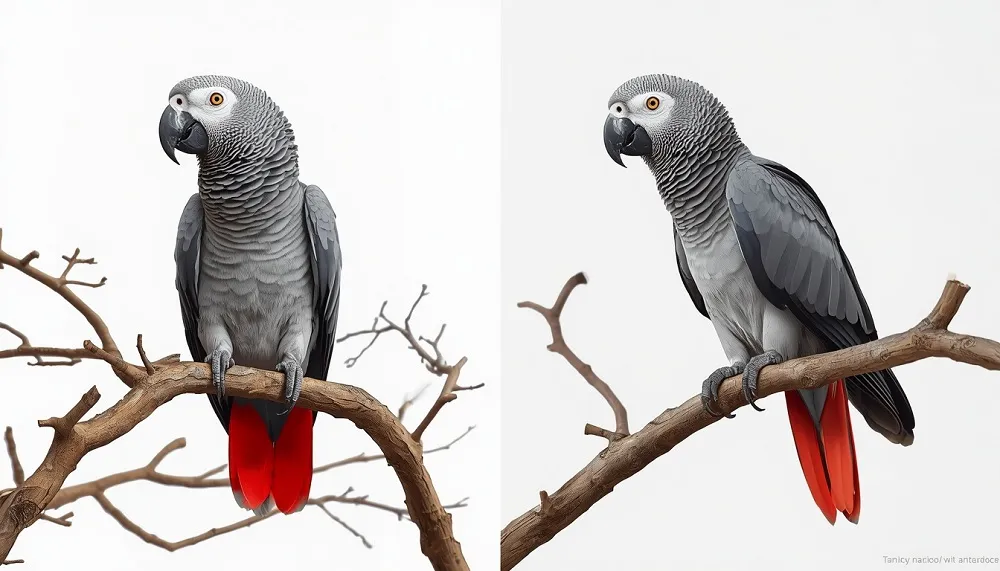
The African Grey Parrot is a medium-sized parrot native to the forests of West and Central Africa. It has pale grey feathers, a black beak, pale yellow eyes, and a bright red tail that makes it easy to identify at a glance.
There are two recognised types, and people searching for a “timneh african grey” are often trying to work out the difference between them.
Congo African Grey vs Timneh African Grey
The Congo Grey is the larger of the two, with lighter grey plumage and a bright red tail. The Timneh Grey is smaller, has darker charcoal grey feathers, and a maroon rather than bright red tail. Timneh Greys also mature slightly faster and are generally considered a touch bolder in temperament. The two were long treated as subspecies of one another before genetic research led to the Timneh being reclassified as its own species, Psittacus timneh. Both are protected under the same international trade rules, so the paperwork requirements are identical.
African Grey Parrot Facts at a Glance
A few African Grey Parrot facts explain why this bird holds such a strong reputation among parrot keepers and researchers alike:
- They can learn to use words in context, not just repeat sounds. Alex, a Congo Grey studied by comparative psychologist Dr Irene Pepperberg for over 30 years, could identify colours, shapes and materials and use around 100 words meaningfully. More recent Harvard research on another grey, Griffin, found he could outperform young children and even undergraduate students on certain visual memory tasks.
- Wild flocks have been recorded using more than 200 distinct calls, including imitations of other birds and even bats.
- They are one of the very few animals shown to share food deliberately with a partner, even when it means going without themselves.
- Their powder-down feathers release a fine dust that keeps plumage conditioned, which is why owners often notice a light film on nearby surfaces.
- They reach independence slowly for a bird, taking around three years before they can fend for themselves and up to five before they are ready to breed.
African Grey Parrot Size
An adult African Grey typically measures 30-33cm from the top of the head to the tip of the tail and weighs between 400 and 550 grams. That puts them in the medium parrot category, smaller than a macaw but noticeably larger than a cockatiel, budgie or lovebird. Their wingspan when fully extended can reach around 65cm, so they need a cage roomy enough for a proper wing stretch and short indoor flights.
Habitat and Range: Where African Greys Come From
African Grey Parrots live in the lowland rainforests of West and Central Africa, including countries such as the Democratic Republic of the Congo, Cameroon, Gabon, Ivory Coast and Ghana. They favour dense forest close to rivers, though they also turn up at forest edges, mangroves and even farmland where fruiting trees remain.
In the wild, they live in large, noisy flocks and roost together in tall trees with hollow cavities for nesting. This social, flock-based lifestyle is worth remembering, because it explains a lot about why pet African Greys crave so much interaction with their human family.
Are African Grey Parrots Endangered?
Yes. The IUCN Red List classifies the African Grey Parrot as Endangered, and it has held Appendix I status under CITES since 2017, the strictest level of international trade protection.
So how many African Grey Parrots are left in the world? Honestly, nobody knows precisely, and that uncertainty is itself part of the story. Estimates range from around 560,000 to 12.7 million birds. That is an enormous spread, but it is not a sign that scientists disagree about the trend; it reflects how genuinely difficult this species is to count. African Greys live deep inside dense, often remote equatorial forest, move in large mobile flocks, and inhabit several countries with limited survey infrastructure, so researchers have to extrapolate from patchy local counts rather than a single reliable census. Different studies also use different methods and cover different time periods, which widens the range further.
What experts do agree on, despite that uncertainty, is the direction of travel. Population trends are consistently downward across the species’ range, and some countries have recorded catastrophic local losses. Ghana, for example, has seen crashes of 90 to 99 percent since the early 1990s. Two main pressures drive the decline: illegal trapping for the pet trade and the loss of the mature forest the birds need for nesting. This is exactly why buying a captive-bred bird with proper CITES paperwork matters so much, a point we come back to later in this guide.
African Grey Parrot Lifespan
African Greys are a genuine lifetime commitment. In captivity, with good diet and veterinary care, they commonly live 40 to 60 years, and some well-documented individuals have lived even longer. Wild birds tend to live shorter lives, averaging around 20 to 23 years, largely due to predation, disease and food scarcity.
Before bringing one home, it is worth asking honestly who will care for the bird in twenty or thirty years’ time. Many rescue organisations exist specifically because owners did not plan for this.
How Smart Are African Grey Parrots?
African Greys are widely regarded as one of the most intelligent bird species on the planet. The best-known example is Alex, a Congo Grey studied for over three decades by Dr Irene Pepperberg, first at the University of Arizona and later at Harvard and Brandeis University. Alex learned to identify colours, shapes, materials and numbers, and used around 100 words with apparent understanding rather than pure mimicry. Pepperberg’s later work with another grey, Griffin, found he could track hidden objects and outperform Harvard undergraduates in a complex memory task, lending further weight to the idea that grey parrot cognition is genuinely sophisticated rather than simply well-trained mimicry.
Wild African Greys also mimic constantly, copying other bird calls and forest sounds as a natural part of their vocal repertoire. In a home, that same skill gets pointed at anything they hear often: doorbells, phone ringtones, the microwave beep, and yes, human speech.
Do African Grey Parrots Talk, and Do They Swear?
Most African Greys do learn to talk, often starting between six months and a year old, though the pace and vocabulary vary a lot between individual birds. Because they repeat whatever they hear regularly, an African Grey living in a household with strong language can pick it up just as easily as “hello” or their owner’s name. This is where African Grey Parrots swearing becomes a real, well-documented issue rather than an internet myth: a grey does not know a word is rude; it only knows the reaction it gets when the word is said, and a laugh or a startled response is often enough to make the phrase a permanent part of its vocabulary. This is not a party trick you can switch off once it happens, so what you say around the cage matters from day one.
What Do African Grey Parrots Eat?
In the wild, African Greys eat a varied diet of fruit, seeds, nuts, leafy matter and occasionally soil or clay, which is thought to help neutralise toxins from certain seeds. As pets, they need that same variety recreated deliberately. A good base is a formulated pellet diet, topped up daily with fresh vegetables, limited fruit, and a controlled portion of nuts and seeds as treats rather than a main meal. Dark leafy greens such as kale and broccoli are particularly valuable, since they supply the calcium and beta-carotene this species needs in larger amounts than most other parrots.
Avocado, chocolate, caffeine, onion, salt and alcohol are all dangerous and should never be offered. Fresh water needs changing daily, since these birds often dunk food in their bowl.
Temperament and Behaviour
African Greys have a reputation for being brainy, and that reputation is well earned, but intelligence in a parrot comes with a complicated personality attached.
Bonding
Greys tend to form an intense bond with one particular person in the household, sometimes called being a “one-person bird.” This does not mean they ignore everyone else, but they often show a clear preference, which can occasionally create friction or jealousy if not managed with consistent, calm handling from all family members from an early age.
Noise levels
They are not among the loudest parrots, but they are far from silent. Expect regular chatter, contact calls when a favourite person leaves the room, and occasional sharp alarm shrieks. A bored or under-stimulated Grey can become considerably noisier as a way of seeking attention.
Affection
Most Greys enjoy head scratches and being near their owner, but many are not natural cuddlers in the way a cockatiel or lovebird might be. Individual personality varies a great deal, and some greys are far more physically affectionate than others.
Biting
African Greys have a genuinely powerful beak, and fear-based biting is common, particularly during adolescence, hormonal periods, or when a bird feels cornered. A fearful reaction to new objects or fast hand movements is well documented in the species and is not a sign of a “bad” bird, just a sensitive one that needs patient, positive handling.
Separation anxiety
Because they are so socially wired, Greys left alone for long stretches can develop anxiety-related behaviours, including feather plucking, screaming, or self-mutilation. This is one of the most common reasons owners end up rehoming a Grey, and it is largely preventable with a realistic daily routine planned out before you buy.
Socialising with families and other pets
Greys can live happily in busy households, including ones with children and other pets, but introductions need to be slow and supervised. Dogs and cats should never have unsupervised access to a parrot, and children need to be taught to read a bird’s body language rather than approach it unpredictably.
Are African Grey Parrots Good Pets?
They can be wonderful companions for the right owner, but they are not an easy first bird. As the behaviour patterns above show, African Greys are highly social, need several hours of interaction and mental stimulation daily, and can become stressed, feather-plucking or noisy if left alone too long.
If you want a bird that is low-maintenance and happy in a quiet cage most of the day, an African Grey is the wrong choice. If you can commit to daily enrichment, training and genuine companionship for decades, they reward that effort with a level of connection few other pets can match.
African Grey Parrot Price in the UK
The price of a talking African Grey parrot in the UK generally sits between £1,500 and £3,000 for a hand-reared, weaned bird from a registered breeder, though listings do appear both below and above that range. Several factors push the price up or down:
| Factor | Effect on price |
|---|---|
| Age (baby vs adult) | Hand-reared babies usually cost more |
| Documentation | Full CITES Article 10 certificate and DNA sexing add £200-£500 |
| Talking ability | Confirmed talkers command a premium |
| Source | Specialist aviaries typically charge more than private sellers |
| Subspecies | Timneh Greys are rarer and can cost more than Congo Greys |
Every legal sale of an African Grey in the UK must include a valid CITES Article 10 certificate, issued by the Animal and Plant Health Agency (APHA). Without one, the sale is not legitimate, regardless of how convincing the seller sounds.
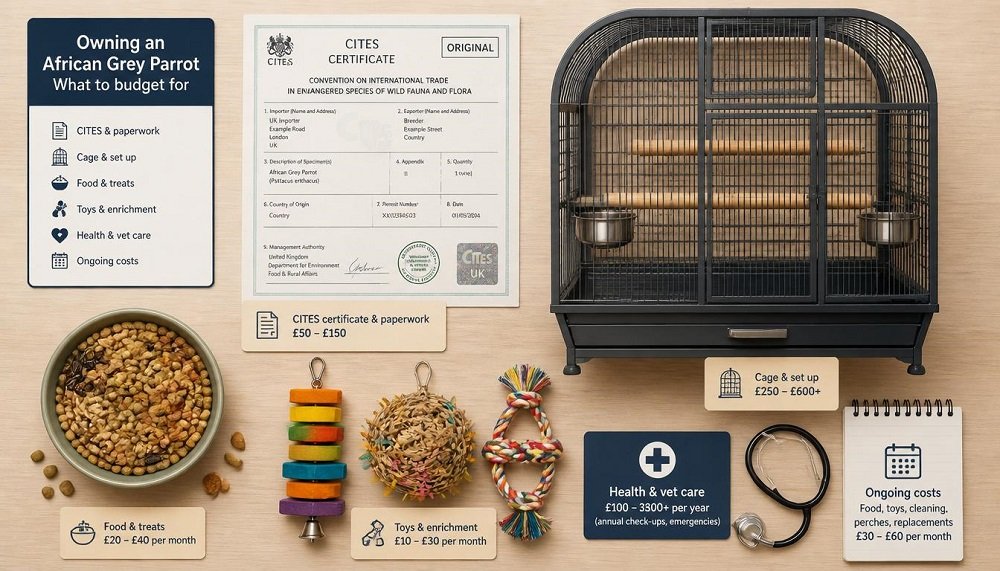
What Does an African Grey Actually Cost in the First Year?
The purchase price is only part of the picture. Here is a realistic first-year breakdown for UK owners:
| Item | Estimated cost |
|---|---|
| Bird (hand-reared, with paperwork) | £1,500-£3,000 |
| Cage (suitably large, one-off) | £250-£600 |
| Toys and foraging enrichment (initial set) | £80-£200 |
| Perches, dishes and accessories | £50-£100 |
| Food (pellets, fresh produce, treats, per year) | £300-£500 |
| Routine avian vet check-ups | £100-£250 |
| Pet insurance (optional, per year) | £150-£400 |
| Estimated first-year total | £2,400-£5,000 |
Ongoing years are cheaper once the cage and larger toys are bought, but food, insurance and vet care remain recurring costs for the whole of the bird’s life, which can easily stretch to four or five decades.
Buying an African Grey Parrot Responsibly
Searches for “african grey parrots for sale near me,” “african grey parrot for sale uk,” “baby african grey parrots for sale near me,” and “african grey parrots free to good home” are all common, and each route can be legitimate, but they need care.
Reputable breeders and aviaries should let you visit in person, show you the parent birds where possible, and hand over CITES paperwork and a DNA sexing certificate at the point of sale. This applies whether you are looking at a baby bird from a local breeder or an adult African Grey advertised further afield. Organisations such as the Parrot Society UK are a sensible starting point for finding contacts across the UK rather than relying on the first local listing you find.
Rehoming and “free to good home” birds are often adult parrots given up because a previous owner underestimated the commitment, not because anything is wrong with the bird. Adopting one can be a genuinely good option, and it is often kinder than buying a baby, since so many adult Greys need new homes. Ask for the CITES paperwork here too, since a legally owned bird should already have it.
Avoid any seller who cannot produce documentation, pushes for a fast cash sale, or offers a price that looks too low for a species this regulated and this long-lived.
Caring for Your African Grey Parrot
Good African Grey care goes well beyond a cage and a food bowl. These are sensitive, intelligent birds, and several everyday details make a real difference to their long-term health.
Sleep
African Greys need around 10 to 12 hours of uninterrupted, dark sleep every night to stay healthy and even-tempered. A cage in a quiet room away from television noise and household traffic, sometimes with a light cover, helps establish a consistent sleep routine. Chronic sleep deprivation in parrots is linked to irritability, screaming and a weakened immune system.
Bathing and Misting
Regular bathing keeps feathers and skin in good condition and helps manage the fine powder-down dust this species produces. Many Greys enjoy a light misting with a spray bottle of plain water, a shallow bath dish, or a supervised turn under a gently running tap. Bathing earlier in the day is best, giving feathers time to dry fully before bedtime, particularly in cooler months.
Humidity and Room Temperature
Coming from humid equatorial forest, African Greys generally do better with moderate indoor humidity rather than the dry air produced by central heating. A room humidity of roughly 40-60 percent, topped up with regular bathing or a room humidifier if your home runs dry, supports healthy skin and feather condition. A steady room temperature in the high teens to low twenties Celsius suits them well, and sudden cold draughts or overheated rooms should both be avoided.
Exercise and Cage Placement
Daily out-of-cage time matters just as much as diet. Aim for at least a few hours of supervised interaction, training or free movement around a bird-proofed room. Position the cage against a wall rather than in the middle of a room, at a height roughly level with a standing adult’s chest, so the bird feels secure rather than exposed. Avoid placing the cage directly in a kitchen, in direct blasting sunlight, or next to draughty windows and doors.
Enrichment and Foraging
A cage should be as large as your space allows, ideally with a bar spacing no wider than about 2cm, plus room for several perches of different textures and diameters to protect the feet. Fill the space with foraging toys, puzzle feeders and safe wood to chew, since boredom is one of the single biggest causes of feather plucking and screaming in this species. Rotating toys every week or two keeps them novel and genuinely engaging rather than becoming background furniture.
Weight Monitoring and Annual Vet Checks
Weighing your Grey on digital kitchen scales every week or two, at the same time of day, is one of the simplest ways to catch health problems early, since birds are prey animals that instinctively hide illness until it is advanced. A steady, gradual weight change is normal; a sudden drop or gain of more than a few percent warrants a vet call. Alongside weight checks, book an annual health check with an experienced avian vet, even when your bird seems perfectly well, to catch subtle problems such as early liver disease or respiratory issues before they become serious.
Toxic Household Hazards
Parrots have an extremely efficient respiratory system, which makes them far more sensitive to airborne toxins than mammals. The best-known danger is PTFE, commonly known by the brand name Teflon, found in some non-stick cookware, certain irons, hair straighteners and self-cleaning ovens. When overheated, PTFE releases fumes that can kill a bird within minutes, often with little warning, so it is safest to switch to stainless steel, cast iron or ceramic-coated cookware in a home with birds.
Other everyday hazards include aerosol sprays and air fresheners, scented candles and wax melts, cigarette or vape smoke, non-stick appliance surfaces such as bread makers and slow cookers, and certain common houseplants including ivy, philodendron, oleander and azalea. Fumes from cleaning products, paint and nail varnish are also best kept well away from any room a parrot uses.
Common Health Problems
African Greys are prone to a small cluster of health issues that owners should know how to recognise.
Feather plucking
Often a sign of stress, boredom, insufficient sleep, or an underlying medical issue rather than a purely behavioural quirk. Persistent plucking always warrants a vet check to rule out physical causes before addressing the environment or routine.
Hypocalcaemia
African Greys are particularly prone to a calcium-related condition that can cause weakness, poor coordination, tremors and seizures, according to the Parrot Society UK. It is most commonly linked to an all-seed diet lacking calcium and vitamin D3, which is one of the main reasons a pelleted, vegetable-rich diet matters so much for this species.
Vitamin A deficiency
A diet too heavy in seeds and too light in vegetables can also cause vitamin A deficiency, which weakens the immune system and can affect the respiratory tract, skin and vision over time. Dark leafy greens and orange vegetables such as sweet potato help address this.
Aspergillosis
A fungal respiratory infection caused by inhaling Aspergillus mould spores, often linked to damp bedding, poor ventilation or a stressed, immune-compromised bird. Signs include laboured breathing, tail bobbing, lethargy and weight loss, and it requires prompt veterinary treatment.
Obesity
A sedentary lifestyle combined with a seed-heavy or fatty diet can lead to obesity, which raises the risk of fatty liver disease and heart problems. Regular out-of-cage exercise and a pellet-and-vegetable-based diet, rather than a nut and seed-heavy one, help keep weight in a healthy range.
Signs that need immediate veterinary attention
Open-mouthed or laboured breathing, sudden collapse or seizures, fluffed-up lethargy that does not improve, a sudden refusal to eat, bleeding, or droppings that change dramatically in colour or consistency are all reasons to contact an avian vet straight away rather than waiting to see if things improve.
Frequently Asked Questions
How long do African Grey Parrots live?
Typically 40 to 60 years in captivity with good care, compared with around 20 to 23 years for wild birds.
How smart are African Grey Parrots?
Among the most intelligent parrot species studied, capable of using words meaningfully rather than just repeating sounds, as shown in decades of research with the parrots Alex and Griffin.
Can African Grey Parrots talk?
Yes, most learn to talk, usually starting between six months and a year old, and they mimic sounds from their environment throughout their lives.
Are African Grey Parrots endangered?
Yes, they are listed as Endangered by the IUCN and protected under CITES Appendix I since 2017.
How much do African Grey Parrots cost in the UK?
Typically £1,500 to £3,000 for a hand-reared bird with full documentation, plus £2,400 to £5,000 in total first-year costs once a cage, toys, food and vet care are included.
Are African Grey Parrots good pets for beginners?
Generally not recommended for first-time bird owners, since they need experienced handling, daily enrichment and a long-term commitment measured in decades.
Do African Grey Parrots need a companion bird?
Not necessarily. A well-socialised, well-stimulated Grey can thrive as an only bird if their owner provides enough daily interaction, though some owners do successfully keep bonded pairs.
Can African Grey Parrots be left alone during the day?
For a few hours, yes, provided they have toys, foraging opportunities and a secure environment. Regularly leaving a Grey alone for a full working day without enrichment increases the risk of stress-related behaviours such as feather plucking.
Do African Grey Parrots need a vet that specialises in birds?
Ideally, yes. Avian medicine is a specialised field, and an exotic or avian-certified vet is far better placed to spot the subtle early signs of illness that this species is prone to hiding.
Is it legal to keep an African Grey Parrot in the UK?
Yes, provided the bird was legally bred and sold with a valid CITES Article 10 certificate issued through APHA. Keeping one without proper documentation can carry serious legal penalties.
Emily Hartley is a UK-based avian care writer with seven years of experience researching parrot welfare, behaviour and responsible ownership for prospective and current bird owners.