
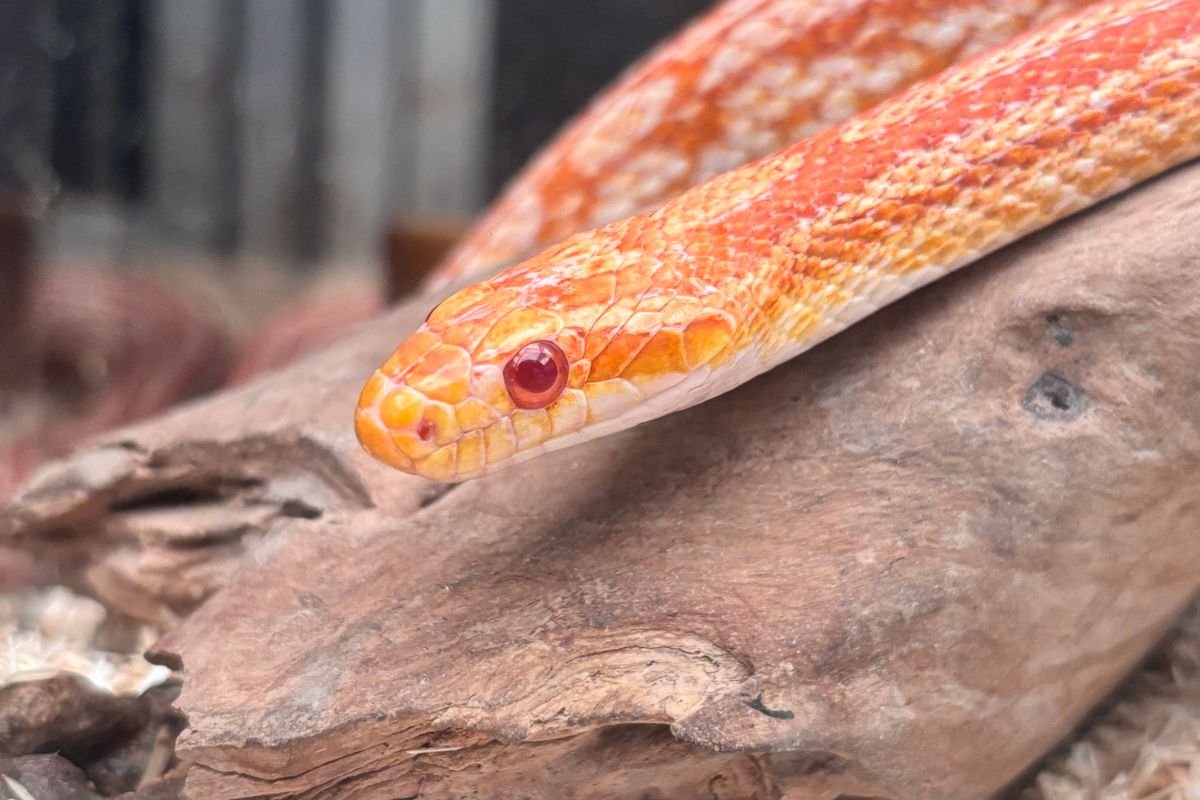
Corn Snake Care Guide UK: Setup, Feeding and Costs
A corn snake is the safest first snake you can buy in the UK: calm, rarely biting, and forgiving of small mistakes. The RSPCA gives a lifespan of 10 to 15 years.
Is a Corn Snake Right for You?
Corn snakes (Pantherophis guttatus) come from the woodlands and farmland of the south-eastern United States. They are non-venomous constrictors, active mostly at dawn and dusk. Adults usually grow to around 120 to 150 cm.
Be honest about three commitments before you buy. First, food: a corn snake eats whole mice, dead and frozen-thawed, for its whole life. Second, time: feeding is quick, but temperature checks and water changes are daily jobs. Third, lifespan: most UK guides give 15 to 20 years.
Buy captive-bred from a reputable breeder or specialist shop, never wild-caught. A healthy snake has clear eyes, a straight spine and a firm grip. Check the RSPCA Find a Pet pages first, as many need rehoming. No licence is needed in the UK, and releasing one is an offence.
Setting Up the Vivarium
Run the vivarium for at least a week before the snake arrives, so you can test the temperatures while the animal is still at the shop. Choose a wooden vivarium: wood holds heat far better than glass. It must be secure and well ventilated. Corn snakes push at the top of the glass and test every seam, so fit a lock: escape is the commonest way corn snakes die in captivity.
Vivarium size
The RSPCA rule is simple: the vivarium must let the snake stretch out fully, at least as long as the snake and at least a third of its length wide and high. For a 150 cm adult that means 150 by 50 by 50 cm. Most UK keepers buy the widely cited 120 by 60 by 60 cm (4 by 2 by 2 ft) vivarium, which suits an average adult. Corn snakes climb, so fit branches and a cork tube up the back wall. A hatchling can feel exposed in a large vivarium, so start small; our leopard gecko care guide makes the same point.
Heating and lighting
Corn snakes are ectothermic, so they warm up and cool down using their surroundings. Build a gradient, hot at one end and cool at the other. The RSPCA figures are a basking zone of 28 to 30°C, measured just above the substrate, a cool end of 20 to 24°C, and a night drop to 16 to 20°C. Use a deep heat projector or ceramic heater on a pulse thermostat, guarded so the snake cannot touch it. Every heat source must run through a thermostat: an unregulated heat mat can cause serious burns and is a genuine fire risk.
Sources disagree on night temperatures. The RSPCA says the heat can be switched off at night so the temperature falls to 16 to 20°C, while the Royal Veterinary College advises it should not fall below about 24°C. In a warm modern house the RSPCA range is usually fine, but if your room drops cold at night, use a ceramic heater that gives off no light. Corn snakes also need low-level UVB on a 12 hour cycle: a 2 to 7 percent T5 tube over the warm third, giving a UV Index of 1.0 at the basking spot. Replace the tube every 6 to 12 months. Our bearded dragon care guide covers a lizard that needs far stronger UVB.
Substrate, hides and decor
Give the snake at least two hides, one at each end, so it never has to choose between the right temperature and feeling safe. The RSPCA suggests organic soils or a soil and sand mix, roughly 60 percent soil, 30 percent sand and 10 percent dried leaves. Avoid cedar and pine shavings, and avoid calci-sand and corn cob granules, which can block the gut if swallowed. Add branches, cork bark and fake plants, plus a large, heavy water dish at the cool end. A humid hide with damp moss helps during shedding, and humidity should sit at 40 to 50 percent, measured with a hygrometer.
Feeding Your Corn Snake
Corn snakes are carnivores that eat frozen-thawed rodents and nothing else. Feed inside the vivarium using tongs, and thaw the mouse fully to room temperature first. Never feed live prey: it is unnecessary, a live mouse can injure your snake, and it raises welfare issues under UK law. Size the mouse to the snake: roughly as wide as its thickest part, never wider.
| Life stage | What to feed | How often |
|---|---|---|
| Hatchling | One pinky mouse | Every 5 to 6 days |
| Juvenile | One fuzzy or small mouse | Every 7 to 10 days |
| Adult | One adult mouse | Every 7 to 14 days |
Supplements are not needed on good quality whole prey, according to the RSPCA. Overfeeding is the commonest feeding mistake: an adult fed like a hatchling gets fat, and a fat snake develops liver problems. Do not handle your snake for 48 hours after a meal. The RSPCA gives 48 hours; the Merck Veterinary Manual says three days, so take the longer figure.
Handling and Behaviour
A corn snake that is handled gently and regularly becomes tame quickly, which is one reason it suits first-time keepers. Leave a new snake alone for its first week so it can settle in, then start with short sessions of 5 to 10 minutes, two or three times a week. Scoop it up from below with both hands, never grab from above.
Corn snakes are most active in the evening, so handle them then. A snake pressed against the glass all day is telling you something is wrong: usually the vivarium is too hot, too cold, too bare, or the snake is hungry. House corn snakes singly. Wash your hands before and after handling, because reptiles can carry salmonella, the same rule as in our tortoise care guide.
Shedding
Corn snakes shed regularly as they grow, and a healthy shed comes off in one piece, like a sock turned inside out. Before a shed, the eyes turn cloudy blue and the skin looks dull. This is normal: the snake cannot see well at this stage, so leave it alone. If the shed comes off in patches, add a shallow lukewarm bath for 15 to 20 minutes. After a shed, check the toes and tail tip for retained skin, because a tight ring can cut off circulation. Never pull stuck shed off: soak it instead.
Health: What to Watch For
Most corn snake health problems trace back to the setup, so fix the temperatures and humidity first when something looks wrong. Book a vet visit if you see refusing food for more than two or three feeds, weight loss, wheezing or mucus around the nose, a swollen or soft jaw, lumps along the body, mites, or droppings that stay runny for more than a day or two. Respiratory infection usually means the vivarium is too cold or too damp. Find an exotic vet before you need one: not every practice treats reptiles, and a first consultation typically costs £45 to £75. Our Pet Path guide to pet care covers the same routine.
How Much Does a Corn Snake Cost in the UK?
The snake is the cheapest part: the setup is where the money goes, so buy the adult-size vivarium from the start. Prices below are typical UK prices checked in November 2026, and should be treated as indicative.
| Item | Typical UK cost | How often |
|---|---|---|
| Corn snake, standard morph | £40 to £100 | One-off |
| Corn snake, designer morph | £100 to £400 or more | One-off |
| Vivarium, 120 by 60 by 60 cm wooden | £80 to £150 | One-off |
| Thermostat, hides, branches, substrate | £60 to £120 | One-off |
| Heating and UVB lighting | £50 to £90 | One-off |
| Frozen mice | £8 to £15 | Monthly |
| Annual vet check | £40 to £75 | Yearly |
| Total first setup | £200 to £400 | One-off |
A realistic first year works out at about £300 to £550 all in, and ongoing costs average £15 to £25 a month. Over a 15 year life, one UK reptile guide puts the lifetime cost at roughly £2,750.
The Bottom Line
A corn snake rewards good setup more than any other beginner snake. Give it a vivarium it can stretch out in, a 28 to 30°C basking zone and a 20 to 24°C cool end, both on a thermostat, low-level UVB, a frozen-thawed mouse every week or two, and a lock that actually latches, and you get a calm companion for 15 years or more. Skip the thermostat, feed live prey, or house two together, and the same animal will slowly fail. The three costliest errors are a vivarium that is too small, a missing thermostat, and live prey. Before you buy, tick every item: vivarium running a week, thermostat tested, two hides plus a humid hide, UVB on a timer, and frozen mice in the freezer.
This guide is general information, not veterinary advice. If your corn snake shows any sign of illness, speak to a specialist reptile vet.
Related reading
Bearded Dragon Care Guide UK: Setup and Costs
Leopard Gecko Care Guide UK: Setup and Costs